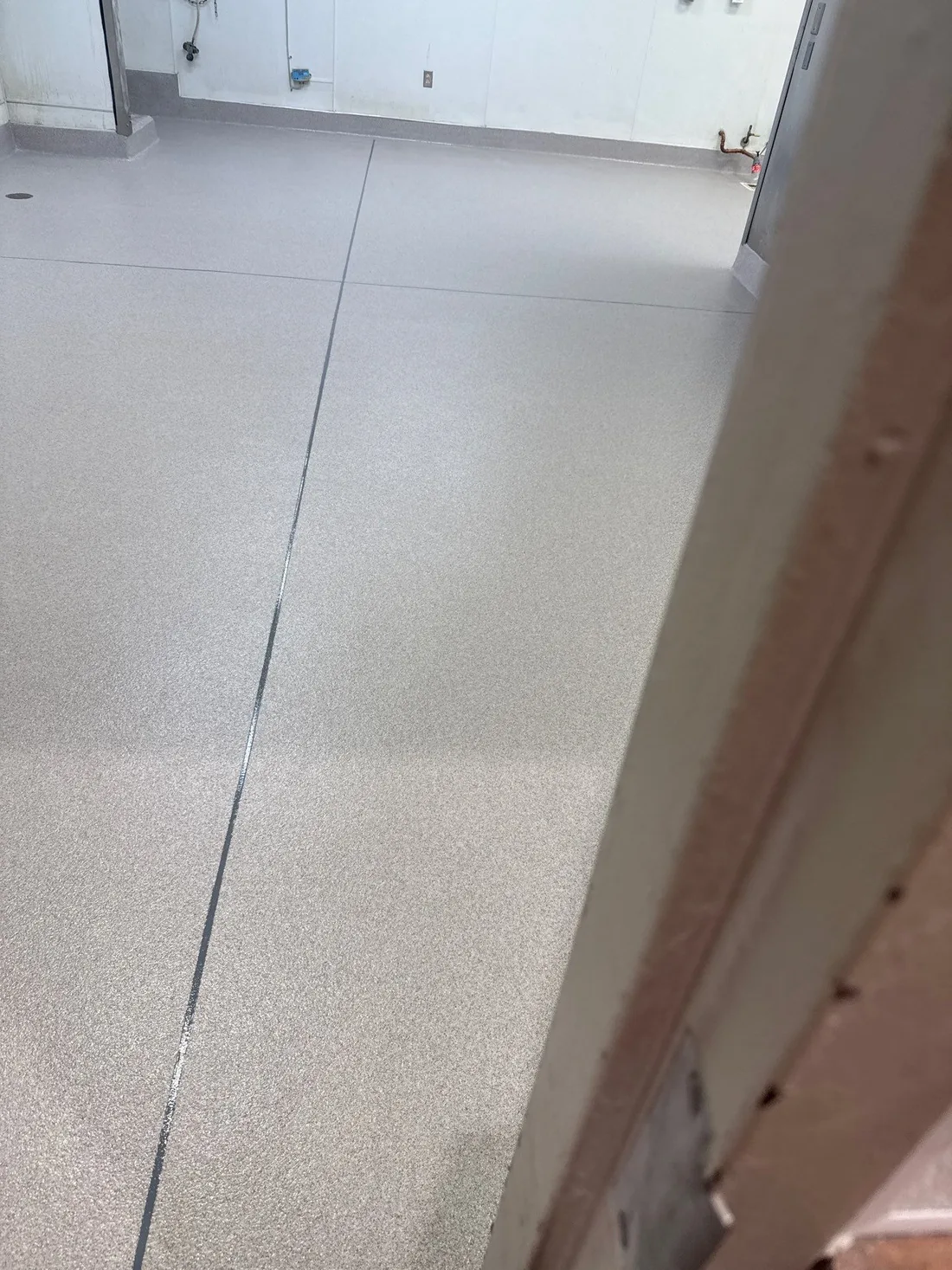
Urethane cement is the heavy duty resinous system built for wet, hot, punishing environments, the floors that food and beverage plants depend on and that break lesser systems.
What is urethane cement, and why do food plants use it?
Urethane cement blends a urethane resin with a cementitious powder and is applied much thicker than a paint-like coating. That build gives it three properties food and beverage production needs: it tolerates moisture in the slab, it survives daily hot washdowns and sanitation chemicals, and it expands and contracts at a rate close to concrete itself. It is the standard answer where water, heat, and cleaning are constant.
Urethane cement or epoxy in a commercial kitchen?
The deciding factor is thermal shock. Hot washdown water dumped on a cold floor makes a coating expand and contract faster than the concrete under it, and repeated cycles crack and debond epoxy in exactly that setting. Urethane cement is formulated for that temperature swing. Kitchens and production areas with daily hot washdowns, steam, and grease usually belong on urethane cement, while dry storage and prep areas can often do well with epoxy at lower cost.
Read the full guide: Urethane Cement vs. Epoxy for Commercial Kitchens
Why do cove base, drains, and slope matter as much as the material?
In a wet facility, the floor is a system, not a surface. Integral cove base runs the flooring up the wall so water and debris have nowhere to collect at the edges. The floor has to slope to its drains, or water ponds, and ponding water fails sanitation audits and shortens any floor’s life. Joint details and transitions at drains and doorways are where wet floors usually fail first, so they deserve as much attention as the field of the floor.
Planning a kitchen or food plant floor?
Washdown temperature, chemicals, and drainage decide the system. Get a free consultation and work through your conditions first.